How to Release an ethrex version
Releases are prepared from dedicated release branches and tagged using versioning.
1st - Create release branch
Branch name must follow the format release/vX.Y.Z.
Examples:
release/v1.2.0release/v3.0.0release/v3.2.0
2nd - Bump version
The version must be updated to X.Y.Z in the release branch. There are multiple Cargo.toml and Cargo.lock files that need to be updated.
First, we need to update the version of the workspace package. You can find it in the Cargo.toml file in the root directory, under the [workspace.package] section. This is also the version the library crates are published under on crates.io when the release is finalized, so it must be a clean semver version (the -rc.W suffix lives only on the git tag).
Then, we need to update five more Cargo.toml files that are not part of the workspace but fulfill the role of packages in the monorepo. These are located in the following paths:
crates/guest-program/bin/sp1/Cargo.tomlcrates/guest-program/bin/risc0/Cargo.tomlcrates/guest-program/bin/zisk/Cargo.tomlcrates/guest-program/bin/openvm/Cargo.tomlcrates/l2/tee/quote-gen/Cargo.toml
We also need to bump the internal crate dependency version pins. ethrex’s library crates declare their workspace-internal dependencies with an explicit version = "X.Y.Z" (required for publishing to crates.io). These live in the root Cargo.toml under [workspace.dependencies], plus a few crates that pin a sibling directly (crates/vm/Cargo.toml, crates/blockchain/Cargo.toml, crates/l2/sdk/Cargo.toml). Bump every one of them to the new version, then confirm none were missed — set PREV to the version you are bumping from:
PREV=X.Y.Z   # the previous release version
grep -rn "\"$PREV\"" --include=Cargo.toml .   # must return nothing
Warning
The version bump must cover both
[workspace.package].versionand these dependency pins. If you bump only the workspace version, the release-branch PR still merges cleanly, but the merged result declares every crate at the new version while requiring the previous version of its siblings — which breaks the entire workspace build (everycargojob fails to resolve).
After updating the version in the Cargo.toml files, we need to update the Cargo.lock files to reflect the new versions. Run make update-cargo-lock from the root directory to update all the Cargo.lock files in the repository. You should see changes in at most the following paths:
- In the root directory
crates/guest-program/bin/sp1/Cargo.lockcrates/guest-program/bin/risc0/Cargo.lockcrates/guest-program/bin/zisk/Cargo.lockcrates/guest-program/bin/openvm/Cargo.lockcrates/l2/tee/quote-gen/Cargo.lockcrates/vm/levm/bench/revm_comparison/Cargo.locktooling/Cargo.lock
Then, go to the CLI.md file located in docs/ and update the version of the --builder.extra-data flag default value to match the new version (for both ethrex and ethrex l2 sections).
Finally, stage and commit the changes to the release branch.
An example of a PR that bumps the version can be found here.
3rd - Create & Push Tag
Create a tag with a format vX.Y.Z-rc.W where X.Y.Z is the semantic version and W is a release candidate version. Other names for subversions are also accepted. Example of valid tags:
v0.1.3-rc.1v0.0.2-alpha
git tag <release_version>
git push origin <release_version>
After pushing the tag, a CI job will compile the binaries for different architectures and create a pre-release with the version specified in the tag name. Along with the binaries, a tar file is uploaded with the contracts and the verification keys. The following binaries are built:
| name | L1 | L2 stack | Provers | CUDA support |
|---|---|---|---|---|
| ethrex-linux-x86_64 | ✅ | ❌ | - | - |
| ethrex-linux-aarch64 | ✅ | ❌ | - | - |
| ethrex-macos-aarch64 | ✅ | ❌ | - | - |
| ethrex-l2-linux-x86_64 | ✅ | ✅ | SP1 - RISC0 - Exec | ❌ |
| ethrex-l2-linux-x86_64-gpu | ✅ | ✅ | SP1 - RISC0 - Exec | ✅ |
| ethrex-l2-linux-aarch64 | ✅ | ✅ | SP1 - Exec | ❌ |
| ethrex-l2-linux-aarch64-gpu | ✅ | ✅ | SP1 - Exec | ✅ |
| ethrex-l2-macos-aarch64 | ✅ | ✅ | Exec | ❌ |
Also, two docker images are built and pushed to the Github Container registry:
ghcr.io/lambdaclass/ethrex:X.Y.Z-rc.Wghcr.io/lambdaclass/ethrex:X.Y.Z-rc.W-l2
A changelog will be generated based on commit names (using conventional commits) from the last stable tag.
4th - Test & Publish Release
Testing checklist
Before publishing the release, run through the following checks using the pre-release binaries:
- Upgrade
ethrex-ethdocker-mainnet - Upgrade
ethrex-mainnet-1 - Upgrade
ethrex-prysm - Upgrade
ethrex-teku - Upgrade
ethrex-grandine - Launch multisync on
ethrex-multisync-main - Upgrade a local L2 created with the previous version and run the integration tests
- Run the L2 integration tests with a SP1 prover on the GPU server (
l2-gpu)
The commands for each target follow. The host roster changes between releases — fill in the ones you run and leave the placeholders for the rest. Replace vX.Y.Z-rc.W / release/vX.Y.Z with the version under test.
ethrex-ethdocker-mainnet
ssh admin@ethrex-ethdocker-mainnet
cd eth-docker/
# In .env, set the release tag on this line:
#   ETHREX_SRC_BUILD_TARGET=vX.Y.Z-rc.W
nano .env
./ethd update
./ethd up
ethrex-mainnet-1
ethrex-prysm, ethrex-teku, ethrex-grandine
These are ethrex mainnet nodes paired with different consensus clients (Prysm, Teku, Grandine); the ethrex (EL) upgrade procedure is the same across them.
They run the ethrex binary downloaded from the release in a tmux session, the consensus also runs in its own tmux session.
tmux ls
# gracefully stop ethrex
tmux a -t ethrex
# ctrl-c
exit

wget -q -O ethrex-linux-x86_64 \
  https://github.com/lambdaclass/ethrex/releases/download/v20.0.0-rc.1/ethrex-linux-x86_64
chmod +x ethrex-linux-x86_64

./ethrex-linux-x86_64 --version # ethrex/v20.0.0-

tmux new-session -d -s ethrex \
  'cd ~ && RUST_LOG=info ./ethrex-linux-x86_64 \
     --http.addr 0.0.0.0 --http.api eth,net,web3,admin \
     --metrics --metrics.port 3701 \
     --network mainnet \
     --authrpc.jwtsecret /home/admin/secrets/jwt.hex 2>&1 | tee -a ~/ethrex-rc.log'
ethrex-multisync-main
ssh admin@ethrex-multisync-main
cd ethrex/tooling/sync/
tmux kill-session -t sync 2>/dev/null || true   # drop a leftover sync session from a previous RC
tmux new-session -d -s sync "make multisync-loop-auto MULTISYNC_BRANCH=release/vX.Y.Z 2>&1"
Check progress later with tmux attach -t sync (detach with Ctrl-b then d).
Local L2 upgrade + integration tests
See Upgrade test for the full procedure.
L2 integration tests with a SP1 prover (l2-gpu)
See L2 integration tests with a SP1 GPU prover for the full procedure.
Publish
Once the pre-release is created and you want to publish the release, go to the release page and follow the next steps:
-
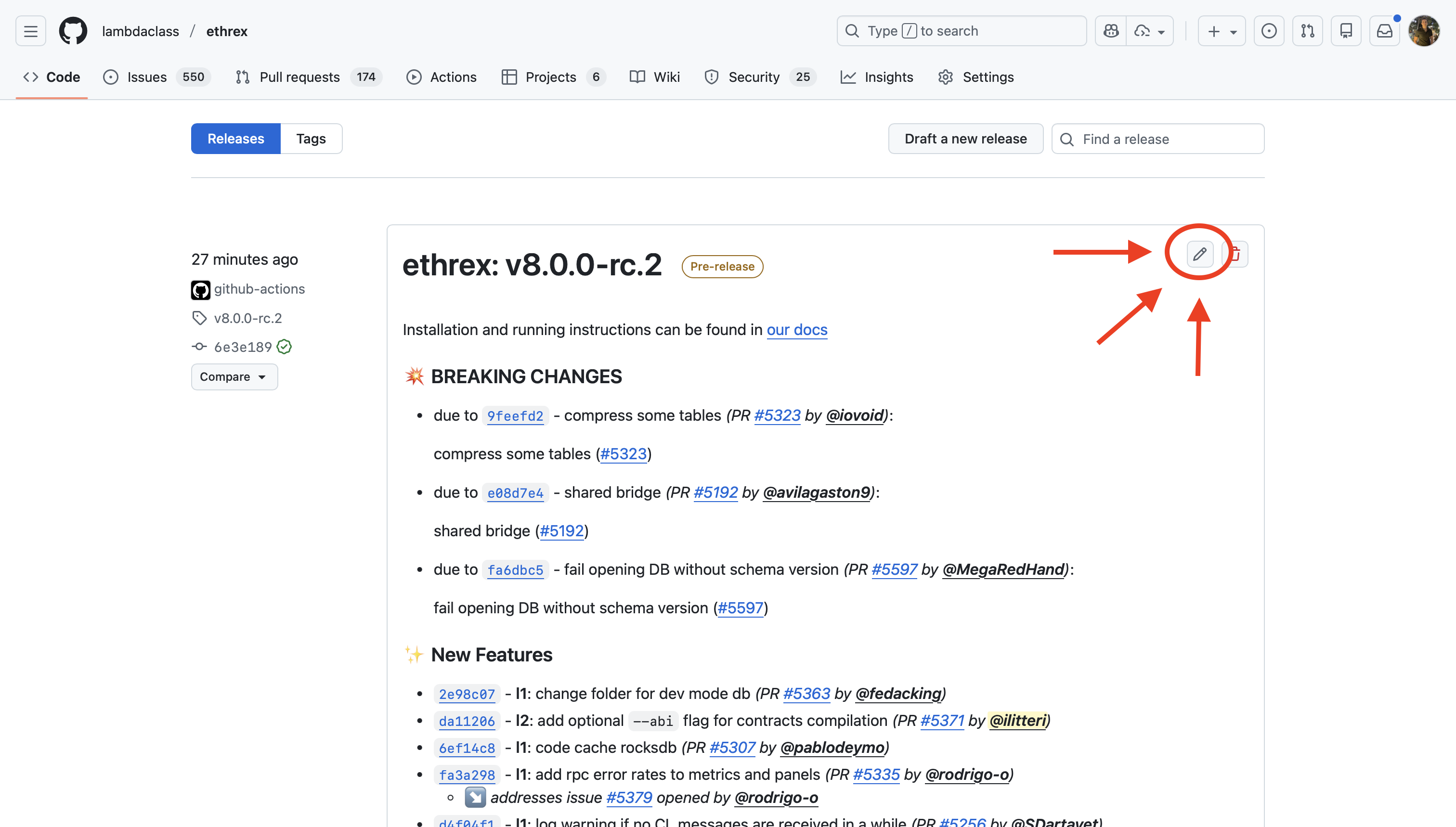
Click on the edit button of the last pre-release created
-
Manually create the tag
vX.Y.Z. Set the tag’s Target to the release branch (release/vX.Y.Z), not the defaultmain— otherwise the tag lands onmain’s HEAD, which is not the version-bumped commit.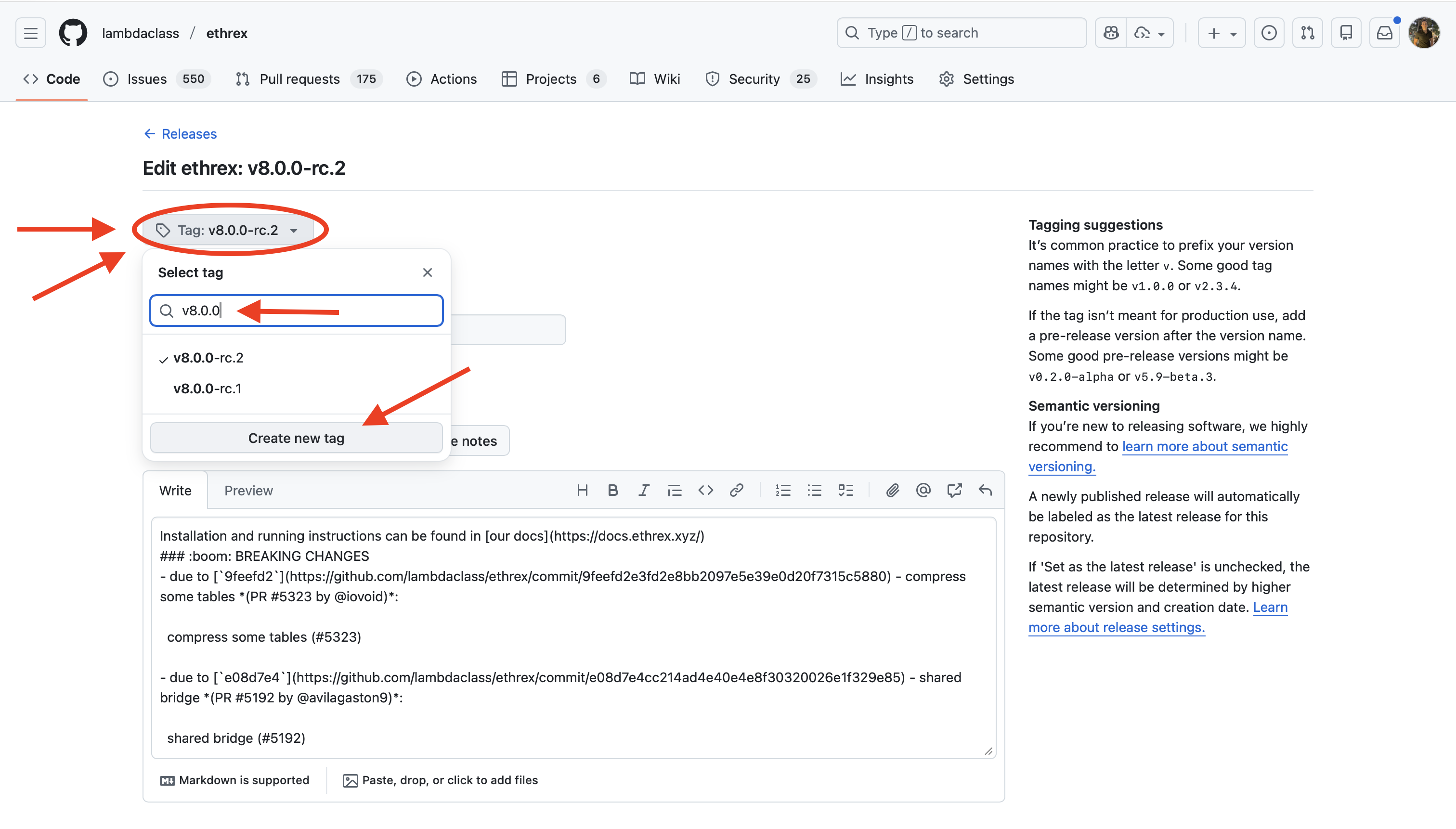
The tag is created on the remote only once you click Update release (step 5) — so verify it after saving (an earlier
ls-remotereturns nothing forvX.Y.Zand falsely “matches” two empty results). The two SHAs must be identical:git ls-remote origin refs/tags/vX.Y.Z refs/tags/vX.Y.Z-rc.W # run after Update release; SHAs must matchIf they don’t match, move the tag to the tested commit before relying on any published artifacts:
git tag -f vX.Y.Z <rc-commit> && git push origin vX.Y.Z --force.Warning
The crates.io publish workflow reads
publish.ymlfrommainbut checks out the tag’s commit. If the tag points at the wrong commit (e.g. an unbumpedmain), the workflow republishes the previous version’s crates — each is “already published”, so the run goes green while publishing nothing new. The finalvX.Y.Ztag must point at the same commit as the testedvX.Y.Z-rc.W(the release branch HEAD you will merge via PR). -
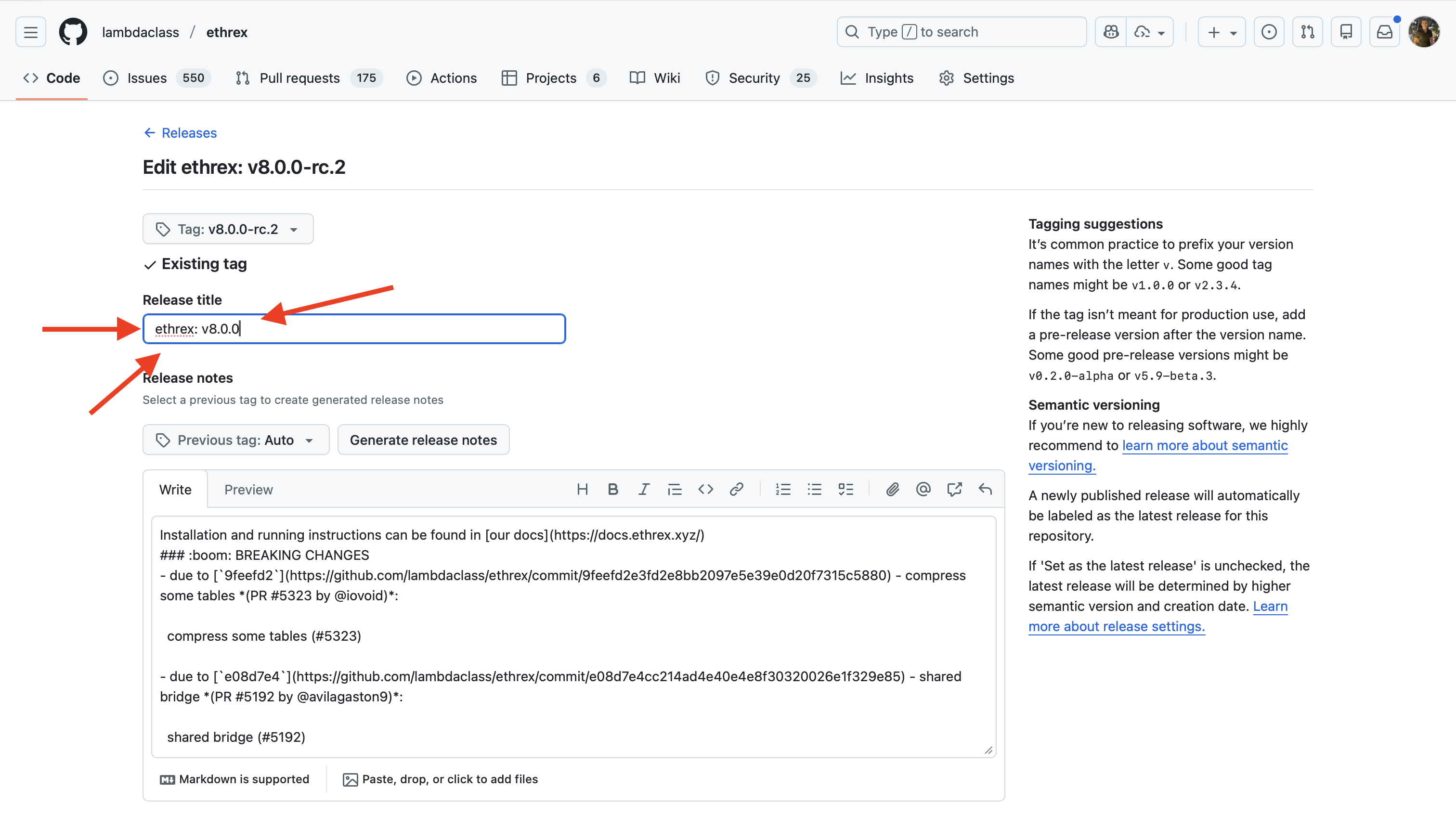
Update the release title
-
Customize the release notes.
The auto-generated changelog lists every commit, but it doesn’t tell operators what actually matters in this release. Above the auto-generated changelog, add a hand-written summary using GitHub alerts. Pick boxes by what the operator needs to decide, in this order:
> [!IMPORTANT]— only when the release carries critical security or correctness fixes. One line stating that upgrading is strongly recommended for all operators.> [!WARNING]— only when the upgrade can’t be cleanly undone or carries a breaking change the operator must account for: a database schema migration you can’t roll back from, a required resync, removed or renamed CLI flags / config options, changed defaults, breaking RPC/API changes, or new minimum requirements (disk, dependency, consensus-client version). State what changes and what the operator must do.> [!NOTE]— always. A What’s new list of the highlights (new features, important fixes), plus a line saying whether a resync is needed (if not already covered above).
Keep the space after
>(> [!NOTE], not>[!NOTE]) and leave a blank line between boxes so each renders separately. Drop the[!IMPORTANT]/[!WARNING]boxes when they don’t apply — a routine release needs only the[!NOTE].> [!IMPORTANT] > This release contains critical fixes. Upgrading is strongly recommended for all operators. > [!WARNING] > This release changes the database schema; once you upgrade you can't roll back to a previous version. The migration runs automatically. > [!NOTE] > **What's new** > - <highlight> > - <highlight> > > No resync is needed. -
Set the release as the latest release (you will need to uncheck the pre-release first). And finally, click on
Update release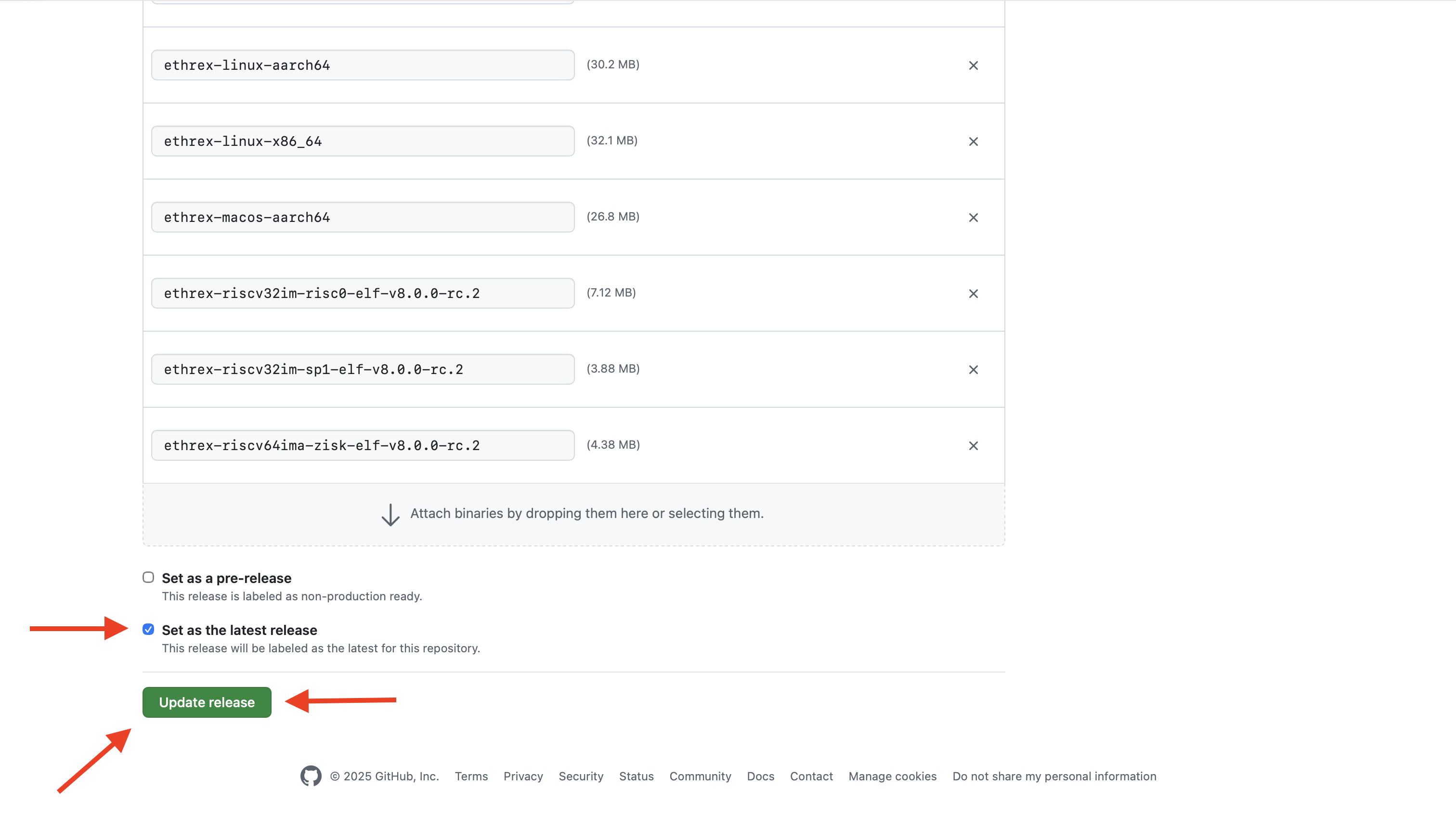
Important
Do the tag rename (
vX.Y.Z-rc.W→vX.Y.Z) and unchecking pre-release in a singleUpdate releaseedit. The automatic promotion fires on that one edit because it both renames the tag and clears the pre-release flag; splitting it across two saves means neither edit carries both signals and thelatesttag is not moved. If that happens, use the manual recovery in Troubleshooting.
Once done, the Ethrex Latest Release workflow (triggered by that edit) will publish new tags for the already compiled docker images:
ghcr.io/lambdaclass/ethrex:X.Y.Z,ghcr.io/lambdaclass/ethrex:latestghcr.io/lambdaclass/ethrex:X.Y.Z-l2,ghcr.io/lambdaclass/ethrex:l2
Promoting the pre-release to a full release also publishes ethrex’s library crates to crates.io — see the next section.
Publishing to crates.io
Promoting the pre-release to a full release (the released event from the step above) triggers the publish.yml workflow, which runs cargo publish for ethrex’s publishable library crates in dependency order, at the workspace version X.Y.Z.
Note
Only the final release publishes to crates.io. Pre-release (
vX.Y.Z-rc.W) tags do not: thereleasedevent does not fire for pre-releases, and crates.io versions are immutable, so a release candidate must never claim the version before it has been tested.
The crates are published at the [workspace.package].version bumped in step 2; the -rc.W suffix lives only on the git tag and never reaches crates.io.
This requires a one-time organizational setup before the first release that publishes:
- A
CRATES_IO_TOKENrepository secret with publish rights for the crates. - A
crates-release-prodGitHub environment (the workflow runs inside it). - crates.io ownership of the crate names (the first publish under the token claims them).
The workflow is idempotent: a crate version already on crates.io is skipped, so re-running after a partial failure is safe. To validate without publishing, run it manually from the Actions tab (the workflow_dispatch trigger) with the dry-run input checked — it lists each crate’s package contents instead of publishing.
5th - Release the rex counterpart
Every ethrex release has a matching rex release with the same X.Y.Z version. Once the ethrex release is fully promoted, release the counterpart:
- In
lambdaclass/rex, bump everyethrex-*dependency pin inCargo.tomltoX.Y.Zand refresh the lockfile (example bump). This step must come after the promotion: the pins resolve against crates.io, so the ethrex crates have to be published first. - Create and push a
vX.Y.Z-rc.Wtag. TheRex Releaseworkflow builds the binaries and creates a pre-release, mirroring ethrex’s flow. - Verify the pre-release, then promote it to
vX.Y.Zthe same way as the ethrex release: rename the tag on the tested commit and untick pre-release in a single Update release edit.
6th - Update Homebrew
Disclaimer: We should automate this
Set the released version once, then the commands below are copy/paste:
export V=X.Y.Z # replace with the released version, no `v` prefix (e.g. 3.0.0)
-
Commit a change in https://github.com/lambdaclass/homebrew-tap/ bumping the ethrex version (like this one). It needs two SHA-256 hashes:
-
Source tarball hash (the
urlfield) — download the GitHub source archive and hash it:curl -L -o "ethrex-v$V.tar.gz" "https://github.com/lambdaclass/ethrex/archive/refs/tags/v$V.tar.gz" shasum -a 256 "ethrex-v$V.tar.gz" -
Bottle hash (the
bottlesection) — build the macOS bottle from the release binary. Theethrexdirectory is the bottle root:# download the L2 macOS binary from the ethrex release gh release download "v$V" -R lambdaclass/ethrex -p ethrex-l2-macos-aarch64 chmod +x ethrex-l2-macos-aarch64 # lay it out as ethrex/<version>/bin/ethrex (last `ethrex` is the binary) mkdir -p "ethrex/$V/bin" mv ethrex-l2-macos-aarch64 "ethrex/$V/bin/ethrex" # strip quarantine flags (root dir is ./ethrex) xattr -dr com.apple.metadata:kMDItemWhereFroms ethrex xattr -dr com.apple.quarantine ethrex # tar and hash the bottle (root dir is ./ethrex) tar -czf "ethrex-$V.arm64_sonoma.bottle.tar.gz" ethrex shasum -a 256 "ethrex-$V.arm64_sonoma.bottle.tar.gz"
-
-
Push the commit.
-
Create a new release with tag
v$Vin homebrew-tap. IMPORTANT: attach theethrex-$V.arm64_sonoma.bottle.tar.gzto the release.
7th - Merge the release branch via PR
Once the release is verified, merge the branch via PR.
Dealing with hotfixes
If hotfixes are needed before the final release, commit them to release/vX.Y.Z, push, and create a new pre-release tag. The final tag vX.Y.Z should always point to the exact commit you will merge via PR.
Troubleshooting
Failure on “latest release” workflow
If the latest / l2 Docker tags don’t get updated after step 5 (the Ethrex Latest Release run skipped the retag, or its assert-latest-promoted job failed), recover with the workflow’s manual path — no local Docker or PAT needed:
- Go to Actions → Ethrex Latest Release → Run workflow.
- Set
rc_tagto the tested release candidate (e.g.v18.0.0-rc.1) andversionto the final version (e.g.v18.0.0). - Run it. The run retags
latest/l2/performance/X.Y.Zfrom the RC image, publishes the apt package, and theverify-latestjob confirms:latestresolves to:X.Y.Z(the run goes red if it doesn’t).
If the registry itself is unreachable through Actions and you must promote by hand, do it server-side so the multi-arch image index is preserved. (A docker pull --platform linux/amd64 … && docker tag && docker push collapses :latest to a single architecture, silently dropping arm64.)
- Create a new Github Personal Access Token (PAT) from the settings.
- Check
write:packagespermission (this will auto-checkrepopermissions too), give a name and a short expiration time. - Save the token securely.
- Click on
Configure SSObutton and authorize LambdaClass organization. - Log in to Github Container Registry:
docker login ghcr.io. Put your Github’s username and use the token as your password. - Retag the RC images to the release tags (server-side, multi-arch index preserved — same operation the workflow performs):
docker buildx imagetools create \
  -t ghcr.io/lambdaclass/ethrex:X.Y.Z \
  -t ghcr.io/lambdaclass/ethrex:latest \
  -t ghcr.io/lambdaclass/ethrex:performance \
  ghcr.io/lambdaclass/ethrex:X.Y.Z-rc.W
docker buildx imagetools create \
  -t ghcr.io/lambdaclass/ethrex:X.Y.Z-l2 \
  -t ghcr.io/lambdaclass/ethrex:l2 \
  -t ghcr.io/lambdaclass/ethrex:performance-l2 \
  ghcr.io/lambdaclass/ethrex:X.Y.Z-rc.W-l2
- Delete the PAT for security (here)
Failure on the crates.io publish workflow
If publish.yml fails partway through, fix the cause and re-run the workflow. Crates already published at the release version are skipped (the run tolerates an “already exists” error), so it resumes from the first crate that has not been published yet. Because crates are published in dependency order, a metadata or ordering error in one crate blocks the crates that depend on it, while the ones published before it stay published (crates.io versions cannot be unpublished or overwritten — a fix requires a new version).